Making a living on the web as I do, I find it inconvenient to have to look thru pdfs for data that is ripe for interactive visualization. So I took Pearce's Land Snails of Limestone Communites and Update of Land Snail Distributions in Pennsylvania and added in my own records to create an interactive map of the counties.
Don't know if it works in Internet Explorer, but it works in Chrome and Firefox. Seriously, it's 2011. There is no reason to use Internet Explorer. Let me get on my soapbox and say that Microsoft doesn't give a damn about user experience, web standards, or modern web practices. Use Chrome-- it's the best browser out there. Firefox is fine, too.
Here's the link:
http://kevinripka.com/pasnails/
Tuesday, October 25, 2011

Monday, October 17, 2011
Tricky Triodopsis
I've featured Triodopis species here before but I wanted to drop a quick not on identifying the congeners Tridopsis tridentata (Northern Three-tooth) and Triodopsis juxtidens (Atlantic Three-tooth). Later I'll update this article with some comparison photos but here is a mnemonic to keep in mind:
ATlantic is AT or Above,
Northern is southern.
What's being referred to here is which direction the distal edge of the palatal tooth points in relation to the upper palatal tooth-- the key to differentiation (morphologically).
You can read where I gleaned this identification information at the Carnegie site.
The real reason for this article is that I need a device for myself as I think I may be confusing the two. Often. The article says that 'ridge-and-valley' is mostly Atlantic but I've called most Northern. And, earlier today, I was at Frances Slocum and think I may have seen both in close proximity and couldn't remember for the life of me which was which. But maybe there weren't both. I have to be a little more intellectually vigilant sometimes. However, Slocum is just chock full o' Triodopsis so I don't pay that much attention. It's a 'hiding in plain sight' sort of thing.
I'll try to post pics soon to this article to illustrate the point.
UPDATE: No photos yet but I looked through shells I've collected heretofore and they are all indeed T. tridentata. I believe the shells I collected (and live individuals I saw) on the other side of Slocum are T. juxtidens (but I'm in Ithaca right now and don't have them on me) but that could mean both species are present in the park, albeit different sides of the lake. I don't see any appreciable difference in habitat so I find it fairly interesting.
ATlantic is AT or Above,
Northern is southern.
What's being referred to here is which direction the distal edge of the palatal tooth points in relation to the upper palatal tooth-- the key to differentiation (morphologically).
You can read where I gleaned this identification information at the Carnegie site.
The real reason for this article is that I need a device for myself as I think I may be confusing the two. Often. The article says that 'ridge-and-valley' is mostly Atlantic but I've called most Northern. And, earlier today, I was at Frances Slocum and think I may have seen both in close proximity and couldn't remember for the life of me which was which. But maybe there weren't both. I have to be a little more intellectually vigilant sometimes. However, Slocum is just chock full o' Triodopsis so I don't pay that much attention. It's a 'hiding in plain sight' sort of thing.
I'll try to post pics soon to this article to illustrate the point.
UPDATE: No photos yet but I looked through shells I've collected heretofore and they are all indeed T. tridentata. I believe the shells I collected (and live individuals I saw) on the other side of Slocum are T. juxtidens (but I'm in Ithaca right now and don't have them on me) but that could mean both species are present in the park, albeit different sides of the lake. I don't see any appreciable difference in habitat so I find it fairly interesting.
Sunday, October 16, 2011
Two Cool Finds at Hickory Run State Park
I finally got a chance to run to Hickory State Park in Carbon County, PA over the weekend. During the course of a few hours I stopped in 4 locations along the drive to do some snailing. The first few stops had me thinking it was another common, Northeast Pennsylvania snailing day. Most prevalent were Euchemotrema fraternum (Upland Pillsnail). At each stop I must have counted 10 to 20, mostly juvenile (juveniles identified by proximity to adults). Also common were what I called Philomycus flexuolaris (I don't think they were Megapallifera mutabilis, I remember a lighter foot fringe).

Funny enough, although the snail has widespread records, it was missing from Carbon County. I added it in green in the above map.
Pallifera species


At the first stop my first exciting find was a Pallifera species slug. My last post (wow, way back in June...) was about Pallifera ohioensis (Redfoot Mantleslug). This slug is a different Pallifera. Now, I have to assume it's probably a Pallifera dorsalis (Pale Mantleslug) but I'm not so sure. Pilsbry speaks of a mid-dorsal line of dots, but this slug lacks that. The rest of the descriptions seems pretty close. The slug in my possession is at times gray-blue and others reddish-tan. It has whitish speckles on the mantle which become little cinnamon flecks as above the foot fringe. It measures 10mm so I assume it's immature.
Interestingly I was able to find a few other photos of slugs online with close to the same markings (here and here and here). The biggest difference with mine is the darker markings on its head and tail.
UPDATE: Here it is the next day and I found a similarly marked Pallifera sp. at Frances Slocum State Park crawling on an empty Neohelix albolabris shell. Under the microscope, though, this one exhibits a faint mid-dorsal line of spots but lacks the darker markings (still dark over eye stalks). This slug is only 7mm.
UPDATE: Here it is the next day and I found a similarly marked Pallifera sp. at Frances Slocum State Park crawling on an empty Neohelix albolabris shell. Under the microscope, though, this one exhibits a faint mid-dorsal line of spots but lacks the darker markings (still dark over eye stalks). This slug is only 7mm.
Helicodiscus parallelus
The last stop of my day was where all the action was. Along a single fallen tree I found: more Euchemotrema fraternum, Discus catskillensis, Ventridens ligera, and possibly Zonitoides arboreus (pretty much the same snails I see all the time in my own county). But I also found what I thought was an empty Helicodiscus parallelus. I threw it in one of my little tupperwares I collect in and went home. Today, while inspecting it under the microscope I thought it looked as if there could be an animal inside. Adding a leaf of lettuce and a spritz of water I left it to sit. Later I came back to it and, sure enough, it was crawling around.

This little snail measures 3.25mm. The coolest thing about this is that it's a little blind snail. If you look closely at the photo you'll see that there seems to be no eyes at the top of the tentacles where you normally see them on other snails. I've found empties before in stream drift in Ithaca, but this is my first encounter with a live animal.
 |
| Land Snails of Limestone Communities and Update of Land Snail Distributions in Pennsylvania (Pearce) |
Monday, June 6, 2011
Pallifera ohioensis : Redfoot Mantleslug
Holy crap, how did I miss putting up a post in May? To be fair May is crunch time for birders and our beloved spring migration-- what with birds in their way-more-attractive-than-fall breeding plumages and all. On top of that the weather in Ithaca has finally changed over from frozen tundra to verdant tracts and, since I spend all my time on a computer at work, trekking outside takes way more precedence over blogging. In fact, I've got a whole backlog of images and thoughts to eventually catch up on.

This weekend, however, while at Ricketts Glenn State Park (still Luzerne Co., PA) I was more than pleased to find this little fellow-- what I believe to be Pallifera ohionensis (Sterki 1908), or Redfoot Mantleslug for you kids at home.
This individual was crawling about one foot up on a tree trunk that has provided me quite a bit of action. The week earlier I had found: 2 Anguispira alternata, 1 Xolotrema denotatum, and an at eye-level Euchemotrema fraternum that I noted the body was fully purple (I should mention I'm still not comfortable with the identification of Euchemotrema leai and should probably spend some time to suss the differences out, something about tighter coils, more delicate hairs, and wetter environments which this particular sighting is two steps to a creek). This day, besides the slug, was another Euchemotrema fraternum (this one with dark brownish up top and tan on bottom of body... better start paying more attention).
Looking in Hubricht it seems he lumped Pallifera ohioensis with Pallifera dorsalis (Pale Mantleslug). However, I do see P. ohioensis appearing places online so I guess it still enjoys full species status. In Pilsbry it makes mention of specimens from Douglas Lake, Cheybogan, MI that also have the rusty red and I think the subtext is that Sterki's identification is called into question. It goes on to mention, though, that Sterki had also recorded P. dorsalis and so thought the two species different-- perhaps Pilsbry sticking up for Sterki and more calling into question the Douglas Lake records with the rusty marks. Also, I have seen information floating around out there that P. dorsalis is actually a complex and includes even more species. Did someone say 'ripe for genetic study?'
As far as a description goes this animal is pale with some gray flecking (it reminds me of every cubicle I've ever worked in, a color I call "greige" because it's not quite gray but not quite beige). It has a broken darker line with some darker spots more apparent anterior, but, as you can see from the photo, it has some splotchy gray running most of the body. Extended it was thin and this guy was probably somewhere in the 15 to 20mm range, making this an immature individual (or maybe a P. dorsalis, what do I know?). Full length is 30mm according to Pilsbry (who is giving the measurements according to Sterki). Of course, beside the mantle covering the body except head, the big thing that led me to its immediate identification (thanks to having previously read the Carnegie Museum Slug Key) were the rusty red lines going down it's foot fringe. It's face is gray-blue, and, as far as slugs go, it's just cute as a button.
Here are a couple more photos:


A thing I should have paid attention to is the type of tree that I'm finding so much action on. At least, however, I know exactly where the tree is as it is right on the trail, practically on Route 118 (maybe 1/16 of a mile), and part of a two tree set. I've said it once, and I'll say it again, Ricketts Glenn State Park is an understudied jewel. As a matter-of-fact, so is a lot of Northeastern Pennsylvania.
It's amazing how I find the introduced slugs (Arions, etc.) pretty disgusting but I absolutely love our native Philomycids. I think when the mantle isn't really separated out it makes for a nicer looking creature.
Next article definitely will be "Introducing Ithaca." An exposé on all the introduced species I'm finding here. I swear I've found way more introduced species than natives here!

This weekend, however, while at Ricketts Glenn State Park (still Luzerne Co., PA) I was more than pleased to find this little fellow-- what I believe to be Pallifera ohionensis (Sterki 1908), or Redfoot Mantleslug for you kids at home.
This individual was crawling about one foot up on a tree trunk that has provided me quite a bit of action. The week earlier I had found: 2 Anguispira alternata, 1 Xolotrema denotatum, and an at eye-level Euchemotrema fraternum that I noted the body was fully purple (I should mention I'm still not comfortable with the identification of Euchemotrema leai and should probably spend some time to suss the differences out, something about tighter coils, more delicate hairs, and wetter environments which this particular sighting is two steps to a creek). This day, besides the slug, was another Euchemotrema fraternum (this one with dark brownish up top and tan on bottom of body... better start paying more attention).
Looking in Hubricht it seems he lumped Pallifera ohioensis with Pallifera dorsalis (Pale Mantleslug). However, I do see P. ohioensis appearing places online so I guess it still enjoys full species status. In Pilsbry it makes mention of specimens from Douglas Lake, Cheybogan, MI that also have the rusty red and I think the subtext is that Sterki's identification is called into question. It goes on to mention, though, that Sterki had also recorded P. dorsalis and so thought the two species different-- perhaps Pilsbry sticking up for Sterki and more calling into question the Douglas Lake records with the rusty marks. Also, I have seen information floating around out there that P. dorsalis is actually a complex and includes even more species. Did someone say 'ripe for genetic study?'
As far as a description goes this animal is pale with some gray flecking (it reminds me of every cubicle I've ever worked in, a color I call "greige" because it's not quite gray but not quite beige). It has a broken darker line with some darker spots more apparent anterior, but, as you can see from the photo, it has some splotchy gray running most of the body. Extended it was thin and this guy was probably somewhere in the 15 to 20mm range, making this an immature individual (or maybe a P. dorsalis, what do I know?). Full length is 30mm according to Pilsbry (who is giving the measurements according to Sterki). Of course, beside the mantle covering the body except head, the big thing that led me to its immediate identification (thanks to having previously read the Carnegie Museum Slug Key) were the rusty red lines going down it's foot fringe. It's face is gray-blue, and, as far as slugs go, it's just cute as a button.
Here are a couple more photos:


 |
| Range maps from Land Snails of Limestone Communities and Update of Land Snail Distributions in Pennsylvania (Pearce). SIghting record county (Luzerne) added in yellow. |
Above you see the standard range map I use from Dr. Timothy Pearce. I continually find myself lucky to be (at least part time) in a state that actually has good, current, accessible information. You'll see that, if I'm correct on the identification, this is quite a good record. There are no records from the eastern 2/3 of the state. Here's P. dorsalis for comparison:
Note that P. dorsalis has a wider known range and even does have records for Luzerne County. If this were a breeding bird I'd question my sighting versus the range map, but, seeing as land snails are painfully understudied, it doesn't make me blink an eye. I won't be losing any sleep over calling it a Redfoot Mantleslug.
A thing I should have paid attention to is the type of tree that I'm finding so much action on. At least, however, I know exactly where the tree is as it is right on the trail, practically on Route 118 (maybe 1/16 of a mile), and part of a two tree set. I've said it once, and I'll say it again, Ricketts Glenn State Park is an understudied jewel. As a matter-of-fact, so is a lot of Northeastern Pennsylvania.
It's amazing how I find the introduced slugs (Arions, etc.) pretty disgusting but I absolutely love our native Philomycids. I think when the mantle isn't really separated out it makes for a nicer looking creature.
Next article definitely will be "Introducing Ithaca." An exposé on all the introduced species I'm finding here. I swear I've found way more introduced species than natives here!
Monday, April 25, 2011
Instead of Looking for Easter Eggs...
I did quite a bit of snailing over the Easter weekend. I am fortunate enough that my home in Dallas, PA is not far from plenty of really great habitat. But, more specifically, I am close to the great old growth forest of Ricketts Glen State Park. As such, I managed to steal a couple hours both Saturday and Sunday to do a little snailing and birding at the glen.
The first day I really only worked a small patch where the road and the creek combine. While there was 'shit for birds' as I say when there isn't much bird action, there was certainly no lack of terrestrial mollusks.


One snail that I only found in one spot, but 6 individuals, was Euchemotrema fraternum. I interestingly read a couple days ago a reference by F. Wayne Grimm that this is actually a species complex as he wrote here about the species in Ontario.
They were all under bark that was laying on the ground within 15 feet of the creek. Alongside them were a couple Discus catskillensis and a immature Polygyrid.






The first day I really only worked a small patch where the road and the creek combine. While there was 'shit for birds' as I say when there isn't much bird action, there was certainly no lack of terrestrial mollusks.


One snail that I only found in one spot, but 6 individuals, was Euchemotrema fraternum. I interestingly read a couple days ago a reference by F. Wayne Grimm that this is actually a species complex as he wrote here about the species in Ontario.
Euchemotrema fraternum (Say, 1824) - A complex of at least three distinct forms, represented by pure populations and probable hybrids. As there are anatomical, distributional, and habitat differences, it is unwise to subsume them under "fraternum" and look the other way, hoping that a fascinating evolutionary problem will evaporate, leaving identifications simple. In the U.S. known from Minnesota, Iowa, and Missouri eastward across the Great Lakes Basin to Alabama, North Carolina, and New England (Hubricht, 1985). In Ontario, found frequently in mesic forest situations from Algoma and Temagami southward (Oughton, 1948: 9). Breeding experiments and comprehensive anatomical comparisons are to be undertaken when resources and time permit.
They were all under bark that was laying on the ground within 15 feet of the creek. Alongside them were a couple Discus catskillensis and a immature Polygyrid.

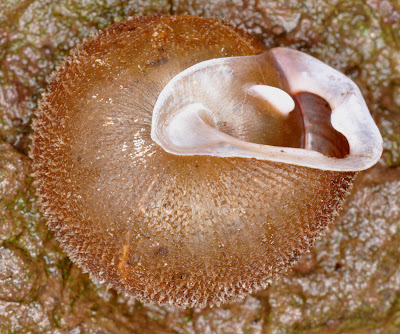
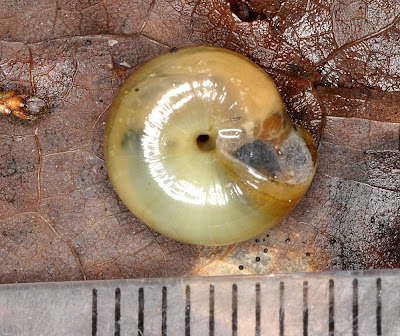
I'm not sure why I didn't take apertural and umbilical views of any of the Discus catskillensis I found, but here is an apical view.
Another snail I found quite a bit of is Triodopsis tridentata. It's probably the polygyrid I find most in my county.


One interesting individual looks as if he had to overcome some traumatic experience as you can see by the deformity of his body whorl getting close to the aperture and some breaklines:


Another snail I found a couple of is Anguispira alternata. The 'Flaming Tigersnails' that I've noted in the park are definitely not that flaming and instead rather dull compared to a some I've seen as far as the shell goes. But their bodies are very varied with purples and pinks.


I really didn't see many empty shells but had one that struck my fancy:


I haven't had a chance to work a key for it but I'm leaning towards Xolotrema denotatum. However, the ones I've seen in the park are thicker than this shell. I'll have to revisit these photos at a later date but compare to below... pretty much the same except thickness. Plus this guy is light colored. Some I've seen are dark, hence the name Velvet Wedge.
The next day I found some different species, as well as had some new birds for my year. I had a singing Veery, which seems like it might be a week or so early but I'm terrible with dates and it could be spot on. Also the forest had my first of year Ruby-crowned Kinglets and Blue-headed Vireos.
Speaking of Xolotrema denotatum, I think here's one that seems to have lost his velvety periostracum that gives them the common name, Velvet Wedge:


I only found 2 introduced species, a single Arion subfuscus and a yellow Arion slug. I've seen a couple of these all yellow Arions in the park but am not sure which species it is. The one I found Sunday was immature and crawling on a log right next to a Philomycus flexuolaris.


Almost forgot, on Saturday I also found what I believe are of the Mesomphix genus, maybe Mesomphix perlaevis or inornatus, but I don't have a field microscope to check on the microsculpture, as it's my understanding you can differentiate the two species I mentioned by the presence or absence of minute papillae (see here):


Another snail of interest, this one from Sunday, was a 9mm Ventridens species that I haven't looked at a key to see if I can identify from my photos. But this little guy was just walking around on the leaf litter near one of the falls. Of course he tucked in the second I leaned down to photograph him. But I'd hide too if something way bigger than me was checking me out.


And the flowers were out:

And some mushrooms :

And one last cool thing I saw over the weekend, although this was at Moon Lake State Park which I just went birding and only lifted a couple rocks, finding this creature: a Smooth Green Snake (Liochlorophis vernalis), the first one I've ever seen. But I'm not a herp guy.

WAIT!! How could I forget about the snail I was most excited to find? At least, I'm reasonably sure of identification, I found 3 Haplotrema concavum in various places, but 2 were in close quarters with an Anguispira alternata and Triodopsis tridentata. For those that don't know, Haplotrema concavum is a snail-eating snail, a real killer. These were at Ricketts.


All very cool stuff! How the hell can anyone be bored when there's this much out there? And I'm only scratching the surface...
Wednesday, April 13, 2011
Ventridens ligera lazarus
Although I've been slow to post lately, I've been busily on the snail. Mostly, right now, I've been scouring the drift materials in the creeks close to my rented room in Ithaca. And though it doesn't do much for locality data it does give me a bumper crop to explore and identify.
Another thing I wanted to do was to start really getting into dissecting so that, when in doubt (*cough succineidae cough*) I could pull out the scalpel, pins, and probe and get to the bottom of things. With that in mind on Monday morning before I left for work (~7am) I dropped a Ventridens ligera (Globose Dome) into a jar of water completely without air bubbles. I went about my day, birding, work, gym, etc and about 10pm I got around to pulling him out for dissection. Sure enough I threw him down in a dissecting tray, walked away for a couple minutes and came back to him right side up. A poke and he was retracted into his shell. Stymied!
I dropped him back in water (so this is about 10:30pm on Monday). Tuesday came and went and I couldn't find time to dissect. Fast forward to a few minutes ago (Wednesday at 10pm) and I looked at the jar, saw the snail really lost most of his color, and figured he had expired. Again I pulled on my gloves and readied my makeshift laboratory (I hope the woman I rent my room from isn't reading my blog because I'm sure snail dissection isn't tops on the list of things she'd like me to be doing in this big manicured house I rent a room in). I placed him on the tray and, sure enough, he retracted in. Curious, I put him under the microscope and could see that he was respirating. This means my little Ventridens ligera (lazarus as a cute play-- I know he didn't die and come back to life, but I had assumed him dead at one point) had been submerged without oxygen for about 48 hours and has not expired. Seems like a fairly long time to be without oxygen. Me, I tend to not go more than 30 seconds at at time without it. Less if I can help it. One of the many reasons I don't swim: I heart oxygen. But apparently little Lazarus doesn't have fully the same feelings, though I'm sure he'd prefer oxygen to a slow watery death if he could communicate.
Interestingly I collected this little fellow along a railroad track that lies in a definite floodplain. It's a little setback from the Susquehanna River-- too far for the river proper to get to, even in the days before the dike, but the creek systems that pour from the mountains to the river to pass right in the spot and the area is very prone to flooding, particularly in spring. In fact, the road that is right next to this area is often closed due to flooding and on either side of the tracks are pools of water that remain year round and overflow during these periods of flood. Along the tracks I found these snails in abundance alongside an unidentified small succineidae species. Mostly they resided under woody and leafy debris.
Part of me wanted to see if I left the snail out if he would be able to recover but I dropped him back in water to dissect another day.
Monday, March 21, 2011
Quantifying Color for Crawling Critters
I wanted my next post on this blog to be a comparative morphology of 3 individuals of Stenotrema hirsutum I have from 3 separate locations, but thinking about this subject brought me to the idea of color.
In my day job as a graphic designer I deal with color quite a bit. I've been fed color theories, color cultural meanings, etc. On top of that, when I used to be a professional photographer I became well versed in the qualities of light and how they relate to color. So color is no stranger in my world-- one of a visual arts professional.
However, the visual is pretty much what I'm most interested in, not only in my career, but in my hobbies. For instance, I am a birder as one of my main hobbies. And, although I'm well versed enough to know their sounds and able to identify solely using that sense, I never care for only hearing a bird. I always want to see it. Snails also are a visual affair for me. While many people probably have never taken the time to appreciate the very subtle beauty of land snails (sure, maybe some other shells like the fancy Cones I only learned of at the MAM meeting), I find quite a bit of visual intrigue in the the subtle gradation of shell features. Plus I find the live animals just plain cute.
Let's face it, the world, including the malacological world, revolves around the visual uptake of information. Proof is that snails aren't usually described base on their textures (at least not tactually, although texture is described visually, but I've never heard a description of the feeling one gets when touching) , their smells (well, maybe Oxychilius alliarius-- aka the Garlic Snail), or their sounds (unless you went to the MAM meeting the other day).
Before I hit too much of a tangent, the reason for this post is to question some of the whys, why-nots, and methods of thinking about color as it pertains to land snails. There are a few things that strike me about the accounts/data of snails I've been reading in Pilsbry and Burch:
Well, it's certainly not 'blue,' 'dark blue,' or 'summer at midnight.' It's best to turn to established color models for the nomenclature.
First, let's buzz through the amateur hour colors of a graphic designer's day. CMYK- no, it's just reflected light, made for what ink can produce. RGB- no it's an additive color model made for what's reproducible on a monitor... no help there.
The color models that really will be helpful and that most graphic designers live in the hazy periphery of are LAB and the Munsell color systems.
Munsell predates the LAB and I believe LAB is just a child of Munsell. I'll leave a wikipedia search for you if you want to find out more. But the main point here is that both are based on the colors that are seeable by the human eye. This would make these ideal methods for describing color, seeing as we'd be hard pressed to find a color not describable by these models, at least, not one we're going to be trying to describe. Side tangent- maybe there are some ultra colors we'd want to describe. Look at crows. To our natural eyes they are just big black birds. But crows actually have an incredible ultraviolet pattern which, apprently, must be seeable by other crows.
Let's go into a few methods I came up that might be viable for your average, everyday snailer to describe color, including their pros and cons.
Method #1: Description By Comparison
The first method that could be useful is comparing a standard color set to the creature. In the graphic design world we use the Pantone color swatches often to make sure inks match up in the printed piece the colors we intended when designing. It's become a standard in the industry. Could we use that same Pantone system for this purpose? Maybe. But limitations include that these swatches only can contain what can be printed (remember, our color models go beyond what ink can do), human error, and the fact that, due to the qualities of light, we would need to make such a comparison in color corrected light so as not to skew the results of the viewer.
Method #2: A Colorimeter
This might be the best method I can think of. While I have experience with a colorimeter for photographic purposes (when I did architectural photography primarily) I have no experience with a full on laboratory colorimeter so I can't speak of its results, how it works, etc. Even Pantone, as mentioned above, has its own colorimeter that, for about $600, you can put up to something and get a color readout. The only potential pitfall (besides price) is that it might not be able to sample extremely small snails. And I have no idea if it reads out colors that are visible by human eye and not reproducible by ink.
Method #3: Photography
Photography is pretty accessible, especially in the digital age. I figure you'd need to take every photo with a color chart and completely correct color balance for consistency. Lighting would also need to be standardized and you would need to light for complete and utter flatness of lighting. Sampling the color from a slight highlight or slight shadow could skew results. Maybe color averages would have to become involved. Then a standardized method would be needed to take those values. Photoshop is pervasive and provides a handy method for this and actually contains pretty much both color models (Munsell is pretty much the HSB-hue saturation brightness- values). We're still up at a wall against the colors that are reproducible, though.
A couple other points I wanted to make, but I'm tired and need to go to sleep, is some standardization. For instance, for semi-transparent shells do you take the color of the empty shell or with the animal in the shell. And pitfalls include trying to quantify the color of shells that have been sitting for some time and changed colors due to environmental factors.
Well, I've prattled on a bit about this subject and have no answers. I've yet to even do so much as a google search on the subject but liked the idea of thinking it out myself. Further questions remain as to proven/useful methods and viable use of the data to both scientists and enthusiasts such as myself. Really, as I started to think out the table of characteristics of my 3 Stenotrema hirsutum I became hung up on the thought of how to best describe the shell and body colors in a scientifically accurate and reproducible manner. Of course, I'll probably still describe my S. hirsutum in the same manner as Pilsbry with colors like 'cinnamon-buff' and 'clay.' Stay tuned for that article.
In my day job as a graphic designer I deal with color quite a bit. I've been fed color theories, color cultural meanings, etc. On top of that, when I used to be a professional photographer I became well versed in the qualities of light and how they relate to color. So color is no stranger in my world-- one of a visual arts professional.
However, the visual is pretty much what I'm most interested in, not only in my career, but in my hobbies. For instance, I am a birder as one of my main hobbies. And, although I'm well versed enough to know their sounds and able to identify solely using that sense, I never care for only hearing a bird. I always want to see it. Snails also are a visual affair for me. While many people probably have never taken the time to appreciate the very subtle beauty of land snails (sure, maybe some other shells like the fancy Cones I only learned of at the MAM meeting), I find quite a bit of visual intrigue in the the subtle gradation of shell features. Plus I find the live animals just plain cute.
Let's face it, the world, including the malacological world, revolves around the visual uptake of information. Proof is that snails aren't usually described base on their textures (at least not tactually, although texture is described visually, but I've never heard a description of the feeling one gets when touching) , their smells (well, maybe Oxychilius alliarius-- aka the Garlic Snail), or their sounds (unless you went to the MAM meeting the other day).
Before I hit too much of a tangent, the reason for this post is to question some of the whys, why-nots, and methods of thinking about color as it pertains to land snails. There are a few things that strike me about the accounts/data of snails I've been reading in Pilsbry and Burch:
- The adjectives used to describe are not exact. Maybe their not as bad as walking into a paint store and seeing nonsense names like 'december mist' and 'autumn night,' but their still not very scientifically precise. Words are used like 'cinnamon-buff' and, one I still have no idea what it is, 'horn' are used. Not very quantifiable or reproducible in my mind.
- Body color descriptions aren't often given. I think it would help to have body colors included to help speciate a live animal, but often this information is non-existant.
- With no exacting data on colors one can't make any postulations based on color. For instance, maybe a link between diet and body color could be made (think Flamingoes and the shrimp they eat). Or habitat and color... or whatever. I'm obviously not a scientist or versed enough in land snails to know if this might be scientifically viable, but I still find this idea stimulating. In birds there is a theory that comes to mind to show, though, that this is likely viable in some way. Unfortunately I don't have the book here in New York with me to quote directly, but, if I remember correctly, the theory says that area that are more wetter and colder have darker, larger individuals of a species while dryer, warmer have smaller, lighter colored birds of a species. And of course there is gradation of the species all in between. (I may have larger and smaller backwards, I'll have to check when I get back to Pennsylvania).
Well, it's certainly not 'blue,' 'dark blue,' or 'summer at midnight.' It's best to turn to established color models for the nomenclature.
First, let's buzz through the amateur hour colors of a graphic designer's day. CMYK- no, it's just reflected light, made for what ink can produce. RGB- no it's an additive color model made for what's reproducible on a monitor... no help there.
The color models that really will be helpful and that most graphic designers live in the hazy periphery of are LAB and the Munsell color systems.
Munsell predates the LAB and I believe LAB is just a child of Munsell. I'll leave a wikipedia search for you if you want to find out more. But the main point here is that both are based on the colors that are seeable by the human eye. This would make these ideal methods for describing color, seeing as we'd be hard pressed to find a color not describable by these models, at least, not one we're going to be trying to describe. Side tangent- maybe there are some ultra colors we'd want to describe. Look at crows. To our natural eyes they are just big black birds. But crows actually have an incredible ultraviolet pattern which, apprently, must be seeable by other crows.
Let's go into a few methods I came up that might be viable for your average, everyday snailer to describe color, including their pros and cons.
Method #1: Description By Comparison
The first method that could be useful is comparing a standard color set to the creature. In the graphic design world we use the Pantone color swatches often to make sure inks match up in the printed piece the colors we intended when designing. It's become a standard in the industry. Could we use that same Pantone system for this purpose? Maybe. But limitations include that these swatches only can contain what can be printed (remember, our color models go beyond what ink can do), human error, and the fact that, due to the qualities of light, we would need to make such a comparison in color corrected light so as not to skew the results of the viewer.
Method #2: A Colorimeter
This might be the best method I can think of. While I have experience with a colorimeter for photographic purposes (when I did architectural photography primarily) I have no experience with a full on laboratory colorimeter so I can't speak of its results, how it works, etc. Even Pantone, as mentioned above, has its own colorimeter that, for about $600, you can put up to something and get a color readout. The only potential pitfall (besides price) is that it might not be able to sample extremely small snails. And I have no idea if it reads out colors that are visible by human eye and not reproducible by ink.
Method #3: Photography
Photography is pretty accessible, especially in the digital age. I figure you'd need to take every photo with a color chart and completely correct color balance for consistency. Lighting would also need to be standardized and you would need to light for complete and utter flatness of lighting. Sampling the color from a slight highlight or slight shadow could skew results. Maybe color averages would have to become involved. Then a standardized method would be needed to take those values. Photoshop is pervasive and provides a handy method for this and actually contains pretty much both color models (Munsell is pretty much the HSB-hue saturation brightness- values). We're still up at a wall against the colors that are reproducible, though.
A couple other points I wanted to make, but I'm tired and need to go to sleep, is some standardization. For instance, for semi-transparent shells do you take the color of the empty shell or with the animal in the shell. And pitfalls include trying to quantify the color of shells that have been sitting for some time and changed colors due to environmental factors.
Well, I've prattled on a bit about this subject and have no answers. I've yet to even do so much as a google search on the subject but liked the idea of thinking it out myself. Further questions remain as to proven/useful methods and viable use of the data to both scientists and enthusiasts such as myself. Really, as I started to think out the table of characteristics of my 3 Stenotrema hirsutum I became hung up on the thought of how to best describe the shell and body colors in a scientifically accurate and reproducible manner. Of course, I'll probably still describe my S. hirsutum in the same manner as Pilsbry with colors like 'cinnamon-buff' and 'clay.' Stay tuned for that article.
Subscribe to:
Posts (Atom)